Evidence record · Northern Ireland
1969 ADThe Troubles Begin
Violence in Northern Ireland escalated into decades of conflict involving communities, paramilitaries, police, and the British Army. The Troubles would mark families, streets, and politics for a generation.
Open the interactive frame→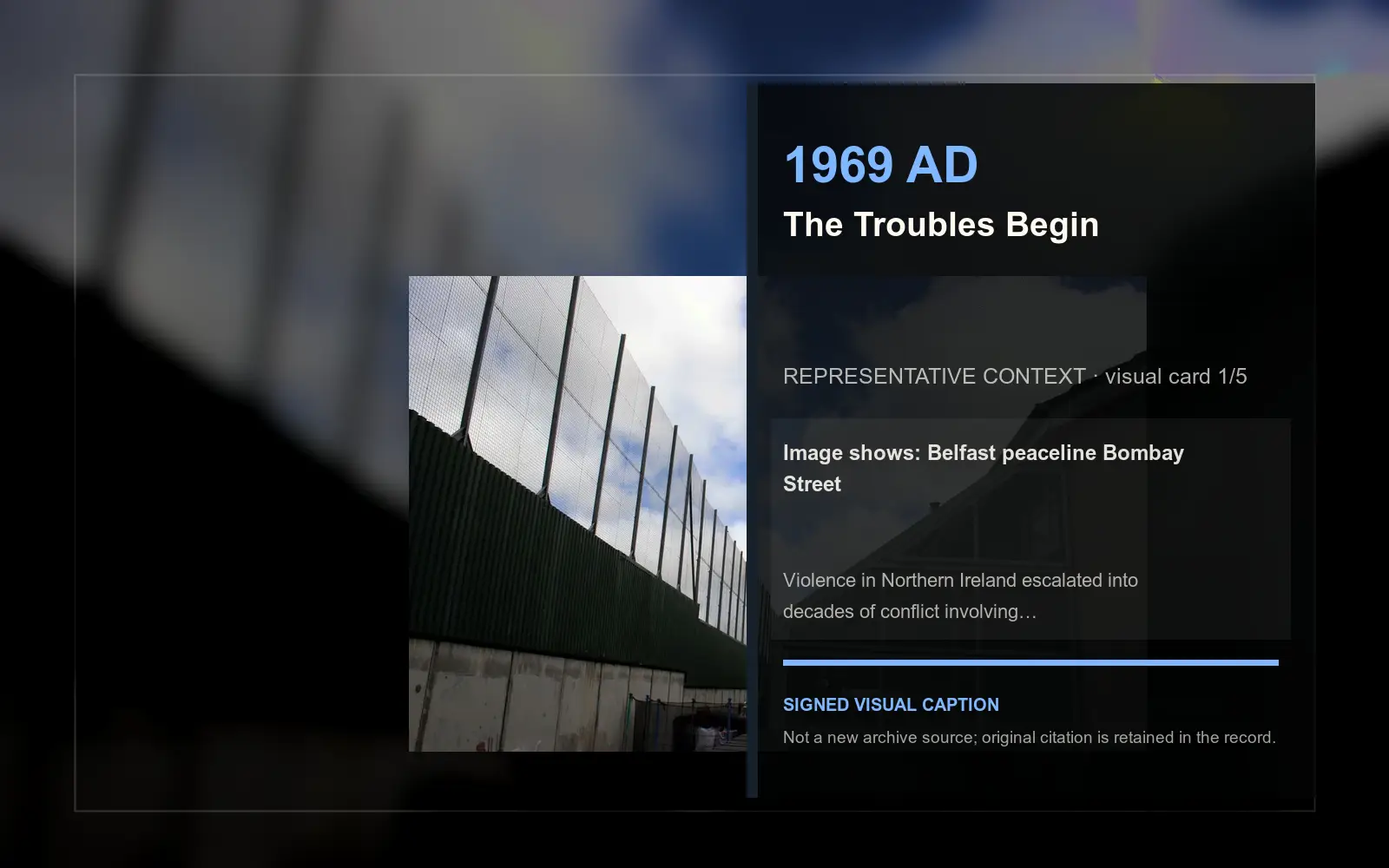
Why it matters
Force made visible
Evidence dossier
Read this moment as a hinge
2 minute source-led readForce changes the field
Read 1969 AD as a hinge, not a label. Violence in Northern Ireland escalated into decades of conflict involving communities, paramilitaries, police, and the British Army. That places “The Troubles Begin” between “Burntollet Deepens the Civil-Rights Crisis” and “Families Are Driven from Belfast Homes”, while immediate harm and the longer construction of consent, accountability and peace had to be held in the same frame.
The rulebook moves
Bring the frame down to one life in Northern Ireland: someone calculating risk with incomplete information and irreversible stakes. The public event is the visible surface; underneath it sits organisation, logistics, targets and the political consequences of violence, intersecting with representation, sovereignty and the institutions entitled to make binding decisions.
What this changes next
The Troubles would mark families, streets, and politics for a generation. Its importance lies in the altered field it leaves behind: the next actors inherit different risks, institutions and choices. Remove this record and the move from “Burntollet Deepens the Civil-Rights Crisis” to “Families Are Driven from Belfast Homes” becomes much harder to explain.
Unexpected angle“Belfast peaceline Bombay Street” is presented through an editorial composite derived from a catalogued visual source. Treat the design as an invitation, not evidence: verify the historical claim in the source ledger and use the constructed frame to ask what no surviving image can show.
Source ledger