Evidence record · Dungannon and Northern Ireland
1964 ADThe Campaign for Social Justice Documents Inequality
Patricia and Conn McCluskey’s organisation publicised discrimination alleged in housing, voting and employment. Its evidence helped turn local grievances into a civil-rights agenda.
Open the interactive frame→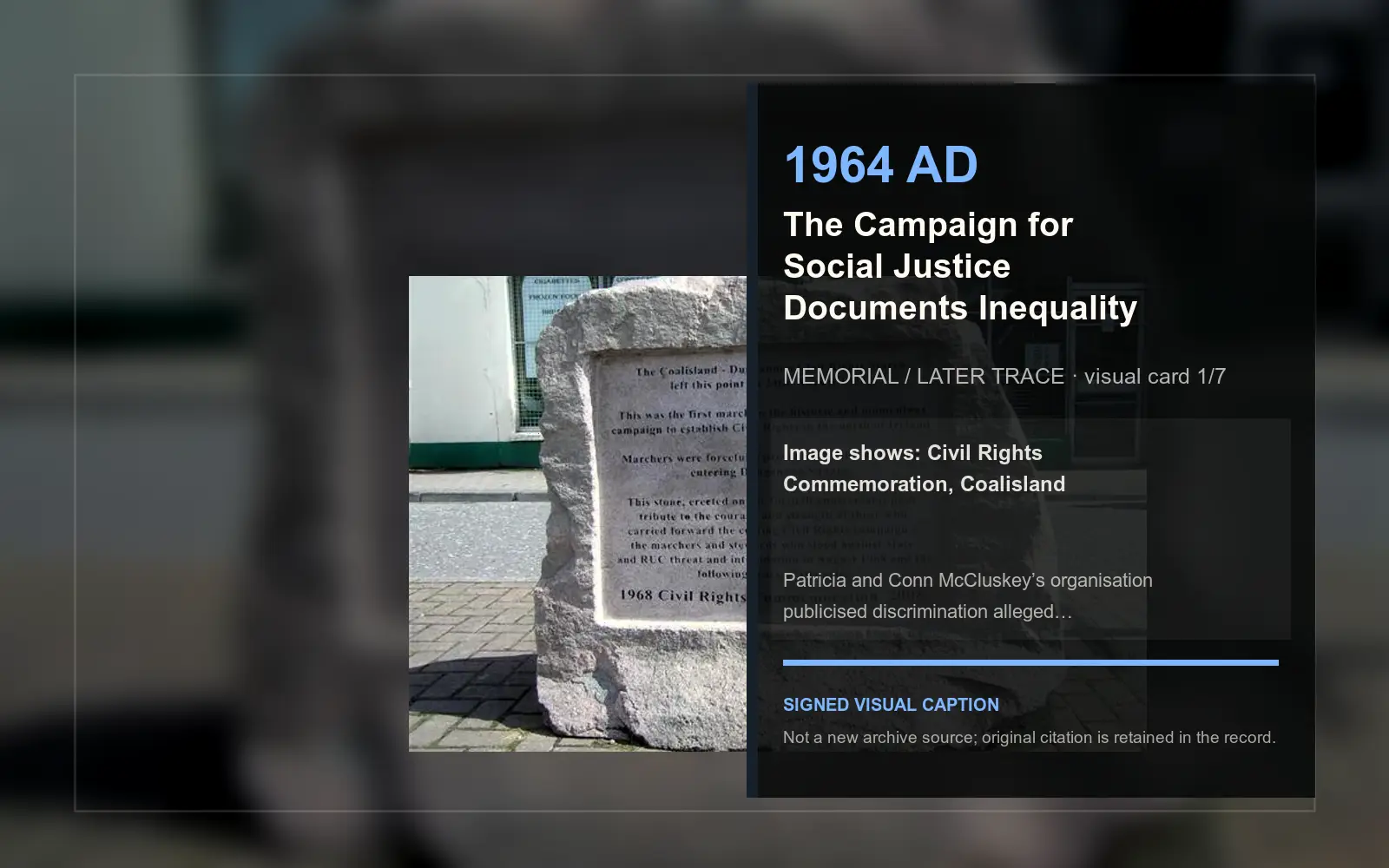
Why it matters
Civil rights made visible
Evidence dossier
Read this moment as a hinge
2 minute source-led readA private grievance becomes public
Read 1964 AD as a hinge, not a label. Patricia and Conn McCluskey’s organisation publicised discrimination alleged in housing, voting and employment. That places “The Campaign for Social Justice Documents Inequality” between “Kennedy Comes Home” and “NICRA Is Formed”, while immediate harm and the longer construction of consent, accountability and peace had to be held in the same frame.
The social contract shifts
Bring the frame down to one life in Dungannon and Northern Ireland: a person testing whether a right written on paper works in a street, home or polling place. The public event is the visible surface; underneath it sits rights, discrimination, organisation and the legitimacy of the state response, intersecting with class, family, welfare, identity and the rules that organise belonging.
What this changes next
Its evidence helped turn local grievances into a civil-rights agenda. Its importance lies in the altered field it leaves behind: the next actors inherit different risks, institutions and choices. Remove this record and the move from “Kennedy Comes Home” to “NICRA Is Formed” becomes much harder to explain.
Unexpected angle“Civil Rights Commemoration, Coalisland” is presented through an editorial composite derived from a catalogued visual source. Treat the design as an invitation, not evidence: verify the historical claim in the source ledger and use the constructed frame to ask what no surviving image can show.
Source ledger