Evidence record · Ireland and Britain
1916 ADMartial Law and Internment Follow the Rising
Authorities arrested thousands and sent many to camps in Britain. Collective detention spread republican networks even among people who had not joined the Rising.
Open the interactive frame→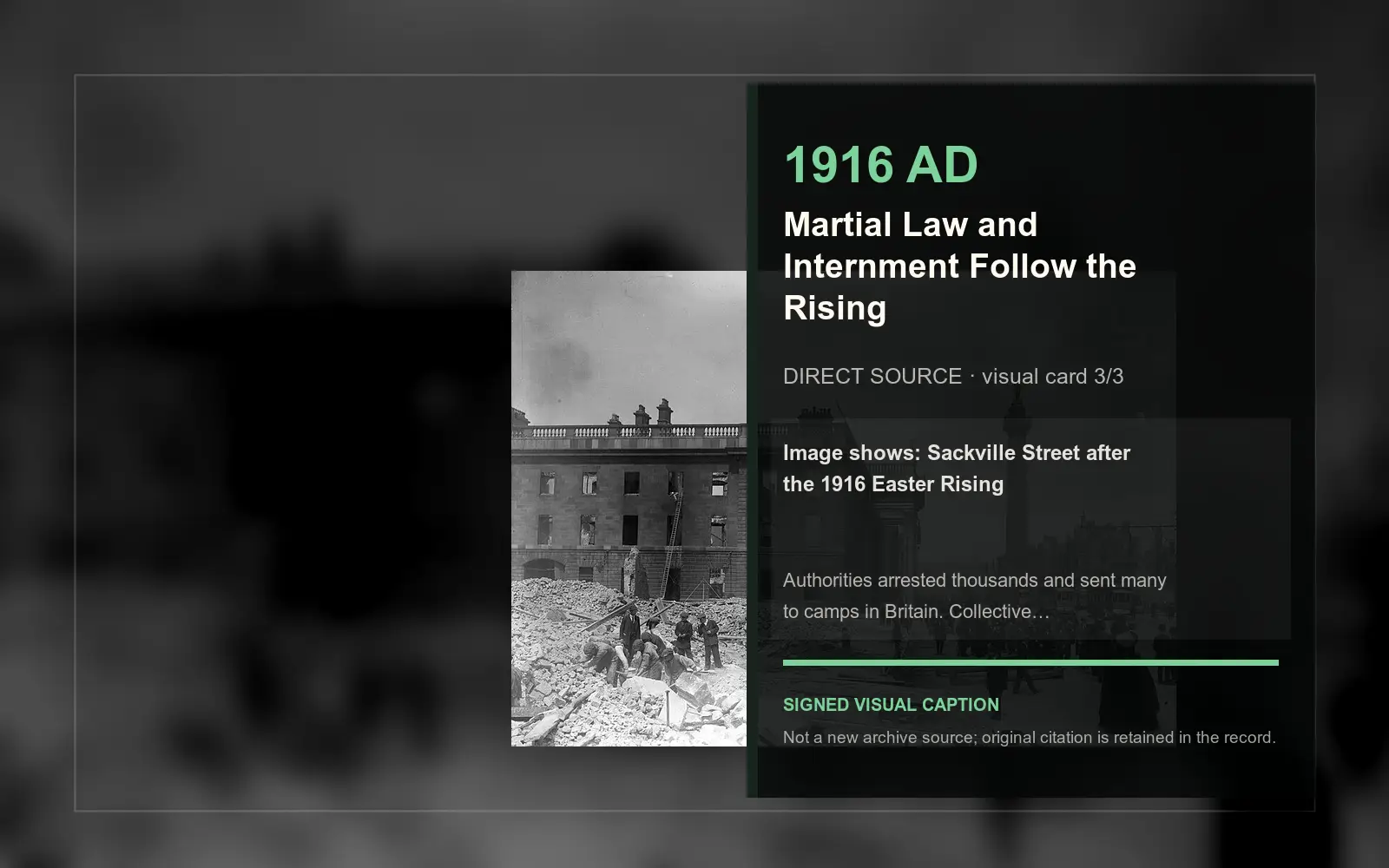
Why it matters
Government made visible
Evidence dossier
Read this moment as a hinge
2 minute source-led readPower becomes procedure
Read 1916 AD as a hinge, not a label. Authorities arrested thousands and sent many to camps in Britain. That places “Martial Law and Internment Follow the Rising” between “Executions Transform Public Opinion” and “The North Roscommon Election Signals Change”, while legitimacy was moving between parliament, street, armed organisation and treaty table.
The social contract shifts
Bring the frame down to one life in Ireland and Britain: the person at the desk—or across it—where policy becomes an instruction. The public event is the visible surface; underneath it sits offices, law, taxation and bureaucracy turning a decision into daily reality, intersecting with class, family, welfare, identity and the rules that organise belonging.
What this changes next
Collective detention spread republican networks even among people who had not joined the Rising. Its importance lies in the altered field it leaves behind: the next actors inherit different risks, institutions and choices. Remove this record and the move from “Executions Transform Public Opinion” to “The North Roscommon Election Signals Change” becomes much harder to explain.
Unexpected angle“Sackville Street after the 1916 Easter Rising” is presented through an editorial composite derived from a catalogued visual source. Treat the design as an invitation, not evidence: verify the historical claim in the source ledger and use the constructed frame to ask what no surviving image can show.
Source ledger