Evidence record · Ireland
1850 ADWorkhouses Become Long-Term Institutions
As emergency schemes vanished, workhouses held children, older people, the sick and families without land. They shifted from temporary deterrent to a permanent part of welfare and health.
Open the interactive frame→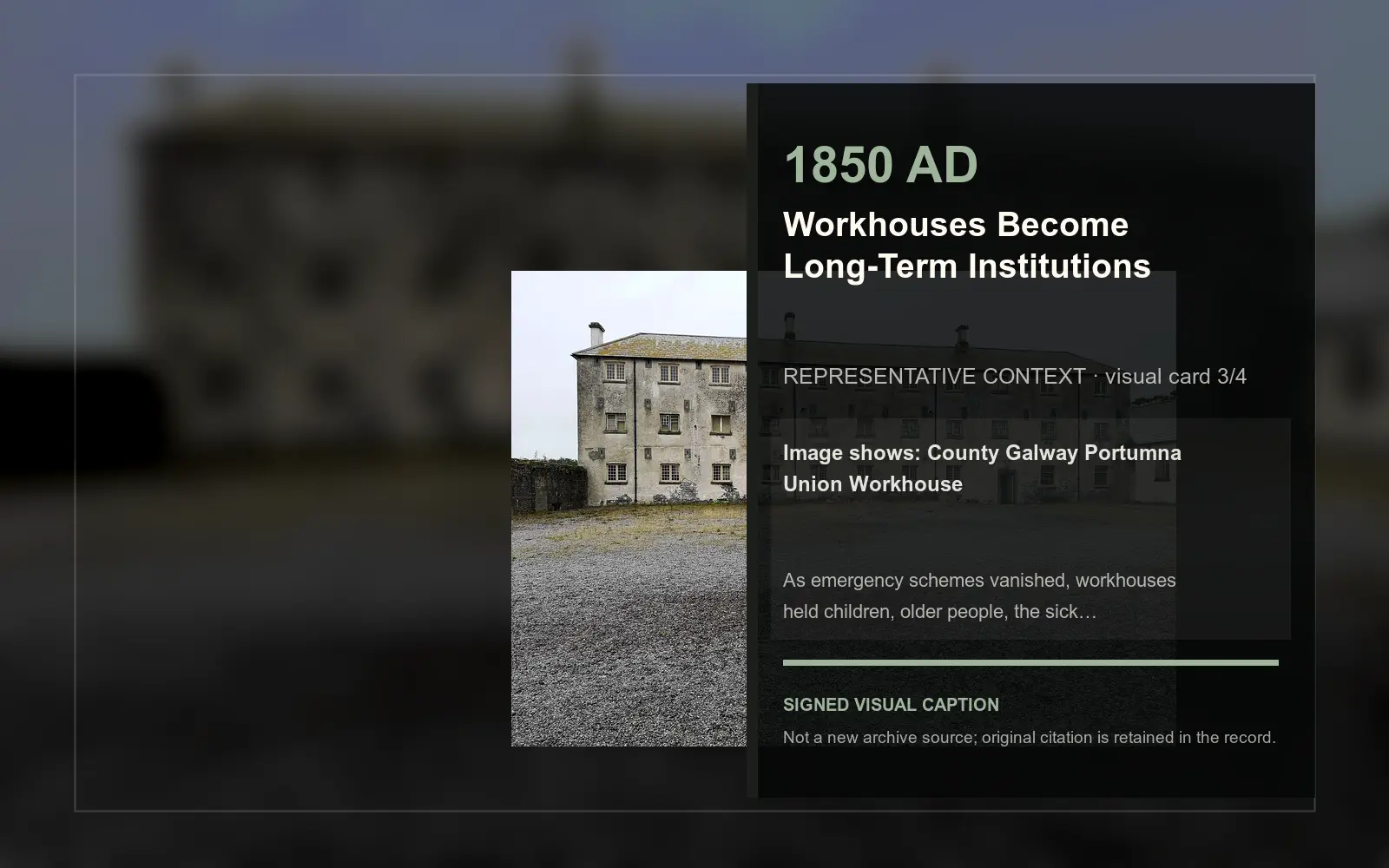
Why it matters
Society made visible
Evidence dossier
Read this moment as a hinge
2 minute source-led readThe social contract shifts
Read 1850 AD as a hinge, not a label. As emergency schemes vanished, workhouses held children, older people, the sick and families without land. That places “Workhouses Become Long-Term Institutions” between “The Tenant Right League Organises” and “Orphans Enter New Systems of Care”, while hunger, relief, eviction and emigration turned policy into a test measured in human survival.
Vulnerability becomes political
Bring the frame down to one life in Ireland: someone learning whether the changing order includes them on equal terms. The public event is the visible surface; underneath it sits class, family, welfare, identity and the rules that organise belonging, intersecting with disease, hunger, care, burial and the capacity of public relief.
What this changes next
They shifted from temporary deterrent to a permanent part of welfare and health. Its importance lies in the altered field it leaves behind: the next actors inherit different risks, institutions and choices. Remove this record and the move from “The Tenant Right League Organises” to “Orphans Enter New Systems of Care” becomes much harder to explain.
Unexpected angle“County Galway Portumna Union Workhouse” is presented through an editorial composite derived from a catalogued visual source. Treat the design as an invitation, not evidence: verify the historical claim in the source ledger and use the constructed frame to ask what no surviving image can show.
Source ledger