Evidence record · Ireland
1847 ADPublic Works Are Closed
Officials wound down the vast work scheme as soup kitchens opened. Families experienced the transition unevenly, and gaps between systems could be fatal.
Open the interactive frame→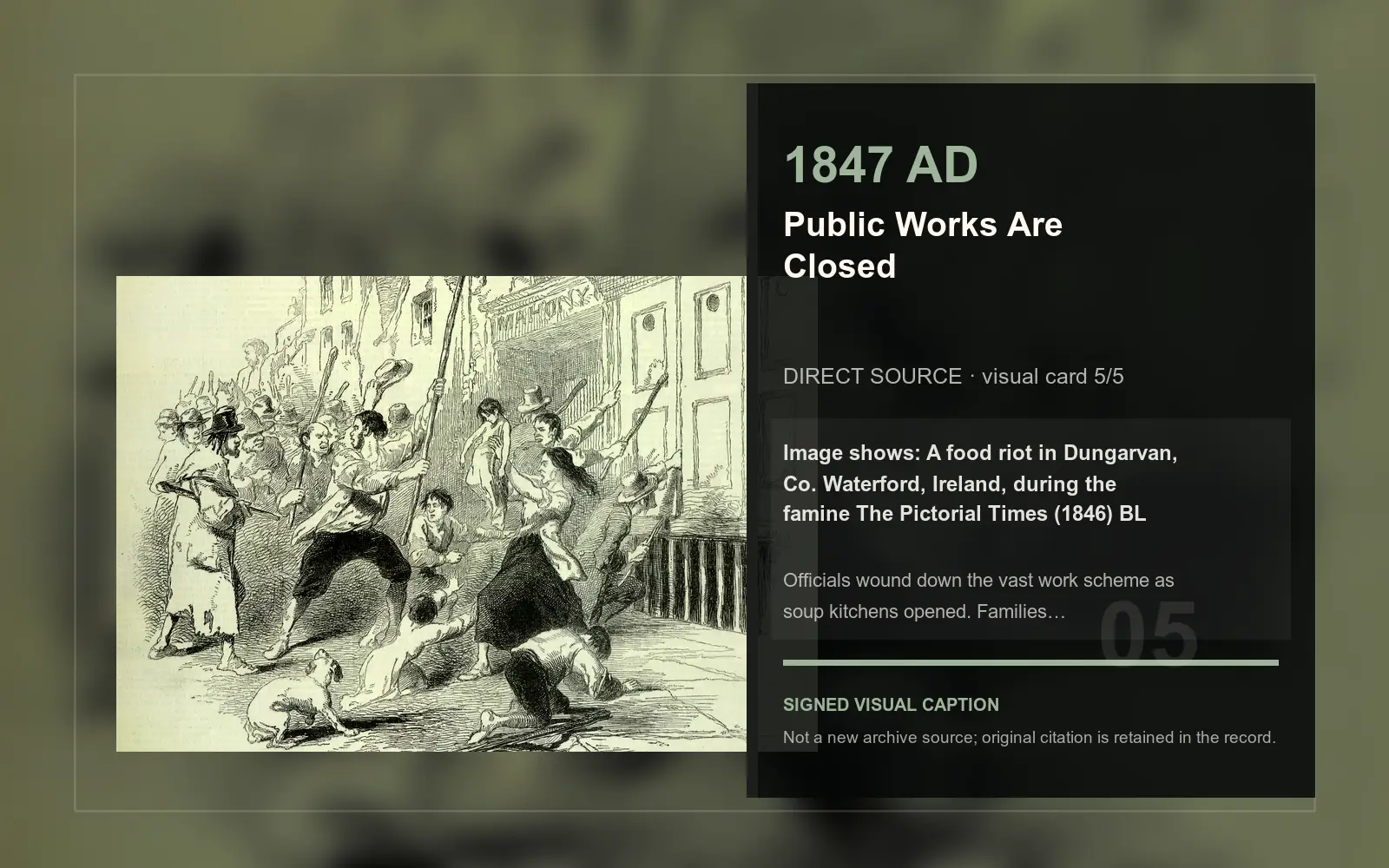
Why it matters
Government made visible
Evidence dossier
Read this moment as a hinge
2 minute source-led readPower becomes procedure
Read 1847 AD as a hinge, not a label. Officials wound down the vast work scheme as soup kitchens opened. That places “Public Works Are Closed” between “Soup Kitchens Feed Millions” and “Grosse Île Becomes a Quarantine Graveyard”, while hunger, relief, eviction and emigration turned policy into a test measured in human survival.
The social contract shifts
Bring the frame down to one life in Ireland: the person at the desk—or across it—where policy becomes an instruction. The public event is the visible surface; underneath it sits offices, law, taxation and bureaucracy turning a decision into daily reality, intersecting with class, family, welfare, identity and the rules that organise belonging.
What this changes next
Families experienced the transition unevenly, and gaps between systems could be fatal. Its importance lies in the altered field it leaves behind: the next actors inherit different risks, institutions and choices. Remove this record and the move from “Soup Kitchens Feed Millions” to “Grosse Île Becomes a Quarantine Graveyard” becomes much harder to explain.
Unexpected angle“A food riot in Dungarvan, Co. Waterford, Ireland, during the famine The Pictorial Times…” is presented through an editorial composite derived from a catalogued visual source. Treat the design as an invitation, not evidence: verify the historical claim in the source ledger and use the constructed frame to ask what no surviving image can show.
Source ledger