Evidence record · Leinster and Munster
1831 ADThe Tithe War Begins
Many Catholics resisted payments supporting the established Church of Ireland. Seizures, protests and violence made tithes a national struggle over religion and rural power.
Open the interactive frame→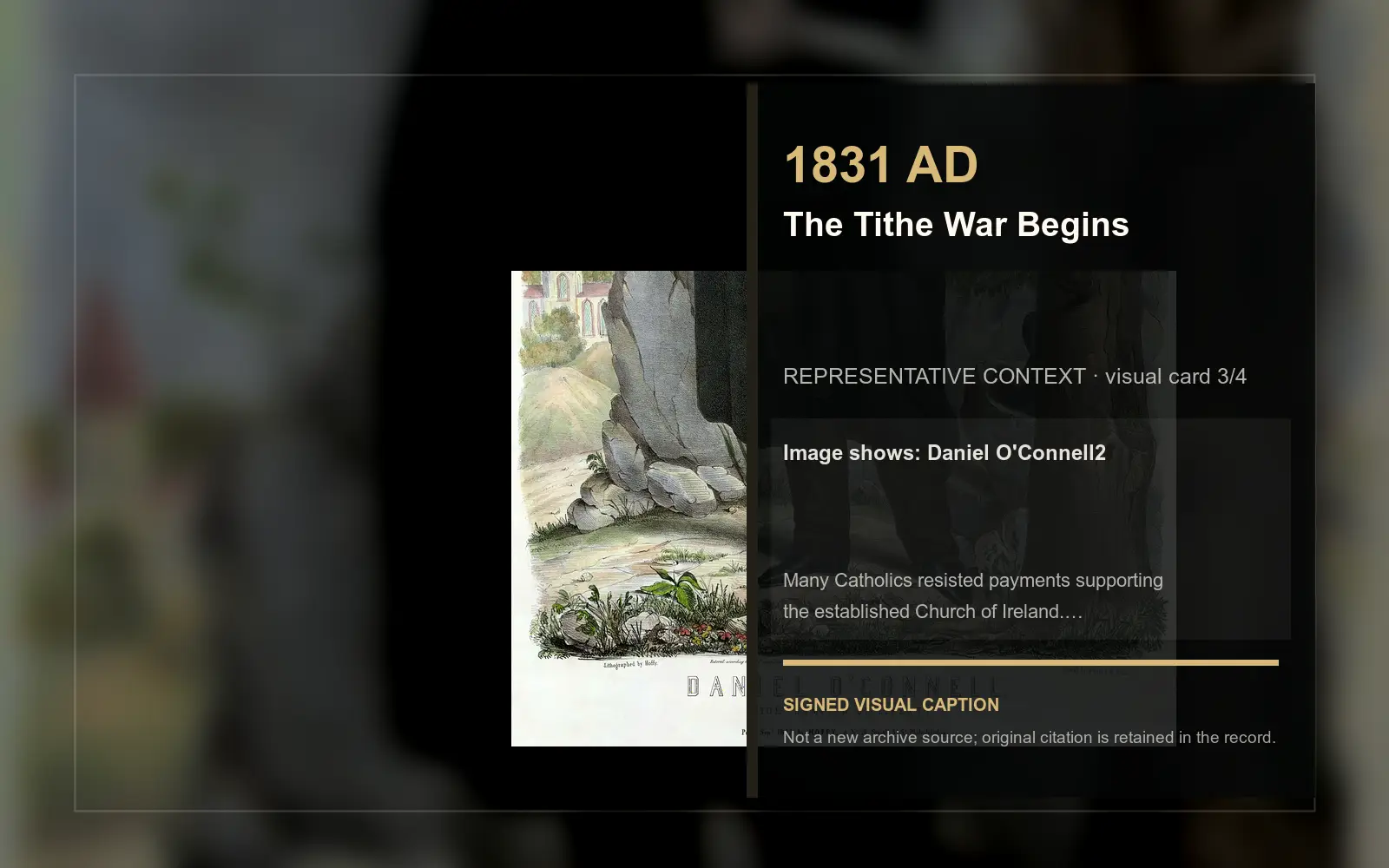
Why it matters
Religion made visible
Evidence dossier
Read this moment as a hinge
2 minute source-led readBelief becomes structure
Read 1831 AD as a hinge, not a label. Many Catholics resisted payments supporting the established Church of Ireland. That places “The Tithe War Begins” between “Catholic Emancipation” and “The Poor Law Builds Workhouses”, while parliamentary manoeuvre, mass organisation and land pressure were competing to define representation.
The social contract shifts
Bring the frame down to one life in Leinster and Munster: a believer whose faith is also being read as a political identity. The public event is the visible surface; underneath it sits confession, law, education, land and belonging reinforcing one another, intersecting with class, family, welfare, identity and the rules that organise belonging.
What this changes next
Seizures, protests and violence made tithes a national struggle over religion and rural power. Its importance lies in the altered field it leaves behind: the next actors inherit different risks, institutions and choices. Remove this record and the move from “Catholic Emancipation” to “The Poor Law Builds Workhouses” becomes much harder to explain.
Unexpected angle“Daniel O'Connell2” is presented through an editorial composite derived from a catalogued visual source. Treat the design as an invitation, not evidence: verify the historical claim in the source ledger and use the constructed frame to ask what no surviving image can show.
Source ledger