Evidence record · Leinster, Ulster and Connacht
1798 ADRebellion Explodes
The United Irish rebellion broke out with French hopes, rural anger, and brutal repression. It failed militarily, but it left behind a republican language that later generations would revive.
Open the interactive frame→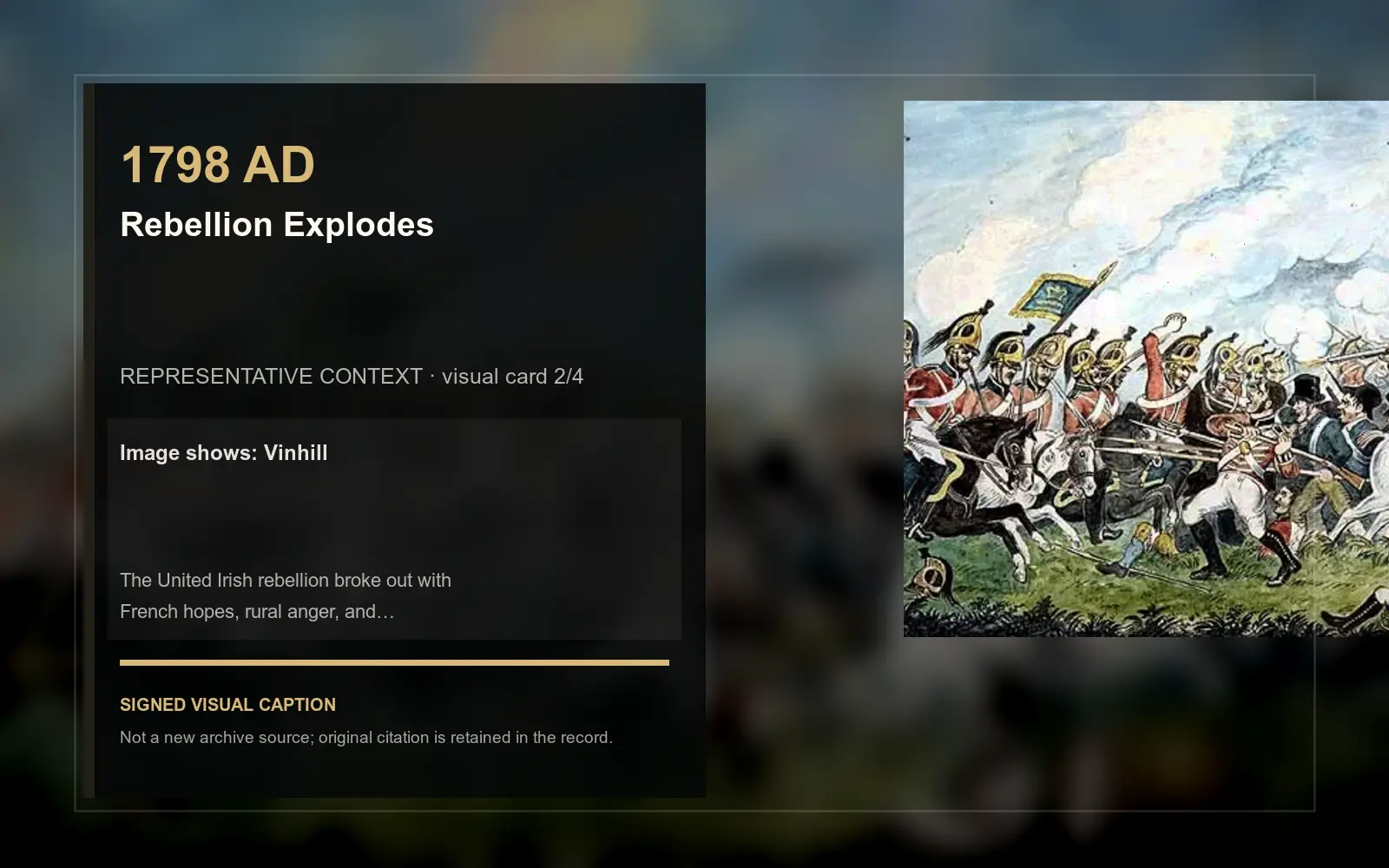
Why it matters
Force made visible
Evidence dossier
Read this moment as a hinge
2 minute source-led readForce changes the field
Read 1798 AD as a hinge, not a label. The United Irish rebellion broke out with French hopes, rural anger, and brutal repression. That places “Rebellion Explodes” between “The French Fleet Reaches Bantry Bay” and “French Troops Land at Killala”, while parliamentary manoeuvre, mass organisation and land pressure were competing to define representation.
Culture doing political work
Bring the frame down to one life in Leinster, Ulster and Connacht: someone calculating risk with incomplete information and irreversible stakes. The public event is the visible surface; underneath it sits organisation, logistics, targets and the political consequences of violence, intersecting with language, ritual, sport, literature and symbols that travel farther than a speech.
What this changes next
It failed militarily, but it left behind a republican language that later generations would revive. Its importance lies in the altered field it leaves behind: the next actors inherit different risks, institutions and choices. Remove this record and the move from “The French Fleet Reaches Bantry Bay” to “French Troops Land at Killala” becomes much harder to explain.
Unexpected angle“Vinhill” is presented through an editorial composite derived from a catalogued visual source. Treat the design as an invitation, not evidence: verify the historical claim in the source ledger and use the constructed frame to ask what no surviving image can show.
Source ledger